Should you buy new builds in Spain?

Is it worth buying new builds in Spain in 2026? A complete guide for investors and buyers.
In 2026, the new build market in Spain remains one of the most attractive in Europe for foreign investors. Chronic supply shortages (only 100–130 thousand properties are built per year against a demand of about 300 thousand), stable demand from expats, digital nomads, and tourists, as well as price increases of 5–15% annually make new builds (obra nueva) an interesting option. But is it worth investing right now? In this detailed article, we will analyze the advantages and risks, current market data, the best regions, returns, and provide a checklist for decision-making.
Why are new builds in Spain popular in 2026?
Spain continues to attract buyers due to its mild climate, quality of life, and stable economy. New builds stand out against the secondary market:
- Modern standards: energy efficiency class A or B (savings on utilities of up to 30–50%), smart home, modern layouts.
- Guarantees: 10-year structural guarantee (LOE), 3 years for suitability, 1 year for finishing.
- Lower repair costs: ready for occupancy or rental immediately.
- Higher liquidity and rental: new properties are rented out faster for short-term (Airbnb) or long-term rentals, especially on the coast.
In 2026, new builds sell faster than secondary properties due to these advantages.
Advantages of investing in new builds in Spain
- Capital growth potential In top locations on the Costa del Sol, Costa Blanca, Costa de Valencia (Valencia, Alicante, Torrevieja, Castellon), experts predict price growth for new builds of 7–15% per year. New builds often show capital gains upon resale after 3–5 years of 25–30% compared to similar secondary properties.
- Rental yield The average gross yield in Spain is 5–12% (net 3–10% after taxes). In tourist areas (Malaga, Benidorm, Marbella), short-term rentals can yield 6–12% and higher. In cities — stable long-term rentals.
- Energy efficiency and future-proof From 2026, energy efficiency requirements are tightening. New homes meet these requirements from the start, which increases value and reduces costs.
- Off-plan purchase (at the construction stage) Prices are lower by 5–20% and there is an option for installment payments (usually 20–30% at the start, the remainder upon completion). Risks are minimized by bank guarantees on advances.
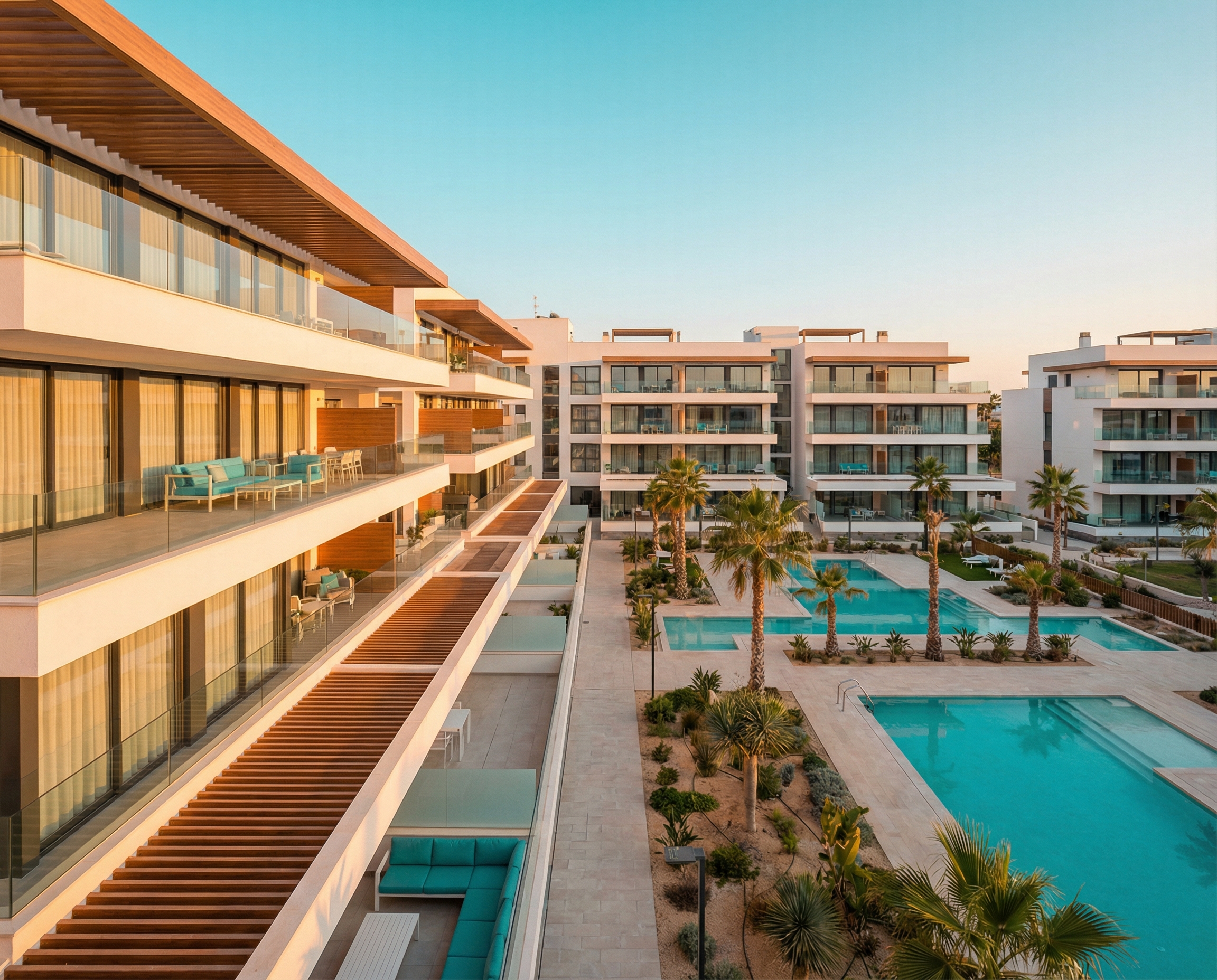
- Additional benefits: urbanizations have pools, fitness centers, security, modern infrastructure.

Disadvantages and risks of investing in new builds
- High entry price: new builds are 10–30% more expensive than secondary properties.
- Off-plan risks: delays in completion (sometimes by 3–9 months), project changes, bureaucracy.
- Slower initial growth: capitalization accelerates after completion and development of the area.
- Taxes and expenses: upon purchase — IVA 10% + AJD (0.5–1.5%), which is 0.5-1.5% more than when buying secondary properties.
- Risks: restrictions on short-term rentals in some cities (Barcelona, Madrid, Valencia).
- Supply shortage: good projects sell out quickly at the project stage (2-2.5 years before completion).
The overall verdict of analysts for 2026: with the right choice of location and developer, the risks are justified, especially on a 5+ year horizon.
Comparison of new builds and secondary properties in Spain in 2026
| Parameter | New Builds (Obra Nueva) | Secondary Properties (Segunda Mano) | Which is more profitable? |
|---|---|---|---|
| Price per m² | Higher (by 10–30%) | Lower | Secondary Properties |
| Price growth (forecast) | 7–15% per year in top locations | 4–15% | New Builds |
| Rental yield | Higher (modern look, amenities) | Lower | New Builds |
| Maintenance costs | Low in the first years | Higher (repairs, energy efficiency) | New Builds |
| Guarantees | 10 years structural | None | New Builds |
| Energy efficiency | Class A/B | Often lower | New Builds |
| Risks | Delays in construction | Hidden defects | – |
Best regions for investing in new builds in 2026
- Costa del Sol (Marbella, Estepona, Benahavis, Malaga): the most premium segment. Growth of up to 9–12%, high rental, golf, yachts. Ideal for luxury investments.
- Costa Blanca (Benidorm, Alicante, Torrevieja, Finestrat): balance of price and yield. Popular among Europeans and investors. Prices are rising by 8–10%.
- Valencia and surroundings: one of the most dynamic markets. More affordable prices (lower than in Barcelona and Madrid), excellent quality of life, growth of 10–14%. Suitable for living + investments.
- Madrid and Barcelona: for long-term rentals and capitalization. Higher prices, but stable demand.
In 2026, suburbs and new urbanizations with good transport accessibility stand out particularly.
For those who want a new build but are limited in budget, we recommend considering less popular construction areas located 10-50 km from major cities.
Current trends in the Spanish new build market in 2026
- Supply shortage continues: supply does not meet demand, which supports price growth.
- Focus on energy efficiency: new properties with solar panels and aerothermal systems.
- Growing interest from expats: Spain remains a top destination.
- Price forecast: +5–15% on average across the country, higher in coastal and capital regions.
- Aggregate return: 15–30% per annum (rental + price increase) in good projects over a 5-year horizon.
Is it worth investing in new buildings in Spain in 2026?
Yes, if:
- You have an investment horizon of 3+ years.
- You choose a reputable developer and a liquid location.
- The goal is a combination of capital growth and rental income.
No or cautiously, if:
- You need quick money (short horizon).
- Your budget is limited and the minimum entry price is important.
In 2026, the market shows no signs of a bubble — the growth is justified by fundamental factors (shortage, demand, safety, climate, large urban development projects). However, always consider diversification and consult with professional real estate agencies.
Checklist before buying a new building in Spain
- Define the purpose (for living, renting, resale).
- Study the location: infrastructure, transport, tourist flow, rental regulations.
- Check the developer: experience, completed projects, bank guarantees.
- Calculate the total cost: price + taxes + notary + annual expenses + management.
- Evaluate profitability: consult with a realtor.
- Visit the property, developer’s office, pilot project.
- Consult with specialists: a trusted realtor, real estate lawyer, tax consultant.
Conclusion: new buildings are one of the best options in Spain in 2026
With a smart approach, investments in new buildings in Spain in 2026 remain profitable due to shortages, modern standards, and sustainable demand. Projects on Costa Blanca, Costa del Sol are particularly attractive — here, quality of life and good ROI combine.
Find many options on our website in the New Building section.
Want a personal recommendation and profitability calculation?
Leave a request — and we will advise you on which option is best for you!
+34627876669 WhatsApp
@sunline4spain Telegram
@sunline.en Instagram for English-speaking clients
@sunline.spain Instagram for Ukrainian and Russian-speaking clients